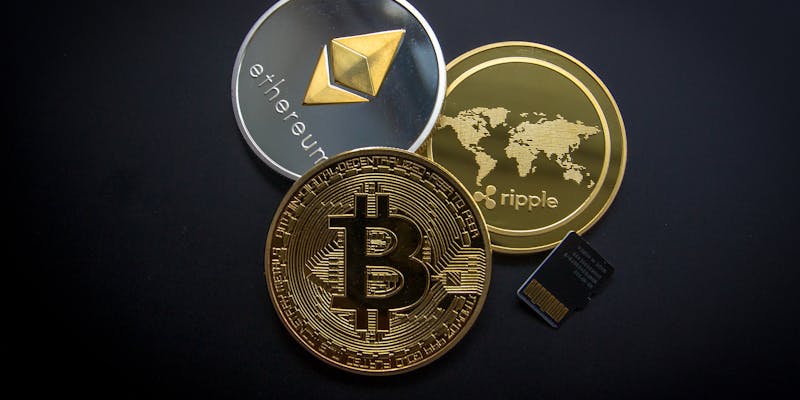
Bitcoin is the first and most famous cryptocurrency, using blockchain technology to enable secure, decentralized transactions without banks. Learn how mining works and why Bitcoin matters.
What is Bitcoin?
Bitcoin is a digital currency—money that exists only on computers and the internet. It's not backed by any government or bank. Instead, Bitcoin is secured by a network of thousands of computers around the world that verify transactions. You can send Bitcoin to anyone in the world almost instantly without needing a bank as an intermediary.
Key characteristics of Bitcoin:
- Decentralized: No single entity controls it
- Limited Supply: Only 21 million bitcoins will ever exist
- Pseudonymous: Transactions are linked to wallet addresses, not real names
- Irreversible: Once sent, Bitcoin cannot be taken back
- Secure: Protected by advanced cryptography
A Brief History of Bitcoin
In 2008, during the financial crisis, an anonymous person or group using the name Satoshi Nakamoto published a white paper titled 'Bitcoin: A Peer-to-Peer Electronic Cash System.' This paper outlined the concept of a currency that didn't require banks or governments. On January 3, 2009, the first Bitcoin transaction occurred, and Bitcoin's network went live.
Satoshi Nakamoto mined the first batch of bitcoins (called the 'Genesis Block') but has never been publicly identified. Some estimate Satoshi holds over 1 million bitcoins worth billions of dollars, but they've never been moved. For many, this is proof that the creator valued the project's ideals more than personal wealth.
How Bitcoin Transactions Work
Sending Bitcoin involves several steps:
Bitcoin mining operation and hardware
1. Initiation: You enter the recipient's Bitcoin address and the amount you want to send.
2. Validation: The network checks that you have enough bitcoins and that the transaction is legitimate using your private key (a unique cryptographic code).
3. Broadcasting: The transaction is broadcast to all Bitcoin miners and nodes across the network.
4. Mining: Miners compete to solve complex mathematical puzzles to validate your transaction. The first to solve it gets to add a block containing your transaction to the blockchain.
5. Confirmation: Once miners confirm your transaction, it's added to the blockchain. You'll typically wait 10 minutes for the first confirmation.
6. Settlement: After 6 confirmations (about 1 hour), the transaction is considered final and cannot be reversed.
Bitcoin Mining: The Engine of the Network
Cryptocurrency wallet and security
Mining is Bitcoin's security mechanism. Miners use powerful computers to solve mathematical problems. When they solve one, they add a new block of transactions to the blockchain. The first miner to solve each block receives a reward: newly created bitcoins plus transaction fees.
This process serves two purposes:
1. It secures the network by making it expensive and difficult to alter past transactions
2. It creates new bitcoins gradually, controlling the supply
Mining becomes progressively harder as more bitcoins are created. Currently, miners receive 6.25 bitcoins per block (this halves every 4 years). The last bitcoin will be mined around the year 2140.
Bitcoin Wallets: Where You Store Your Bitcoin
A Bitcoin wallet is software that holds your private keys—the cryptographic codes that prove you own your bitcoins. There are several types:
Hot Wallets: Online wallets connected to the internet. Convenient but less secure.
Cold Wallets: Offline storage devices. Extremely secure but less convenient.
Paper Wallets: Your private key printed on paper. Secure if stored safely, but risky if lost.
Hardware Wallets: Specialized devices like USB drives that store your keys offline.
Exchange Wallets: Wallets provided by cryptocurrency exchanges. Convenient but you don't control your private keys.
Important: If you lose your private key, you lose access to your bitcoins forever. There's no password recovery or customer support that can help you.
Bitcoin Supply: Why It's Limited
Bitcoin's supply cap of 21 million coins is programmed into its code. This scarcity is by design and is crucial to Bitcoin's value proposition.
As of 2024, approximately 21 million bitcoins have been mined. The remaining bitcoins will be mined gradually over the next 100+ years, with the last bitcoin expected around 2140.
Halving Events: Every 4 years (approximately every 210,000 blocks), the mining reward halves:
- 2009: 50 BTC per block
- 2012: 25 BTC per block
- 2016: 12.5 BTC per block
- 2020: 6.25 BTC per block
- 2024: 3.125 BTC per block
This reduction ensures controlled inflation and will eventually lead to zero new bitcoin creation.
Bitcoin vs. Traditional Money
Aspect | Bitcoin | Traditional Money
--- | --- | ---
Issuer | Decentralized network | Government/Central Bank
Supply | Fixed (21M max) | Can be printed unlimited
Borders | Borderless | Controlled by borders
Transaction Speed | ~10 minutes | Hours to days
Transaction Cost | Minimal | Can be significant
Government Control | None | Complete control
Inflation Risk | None (fixed supply) | Potential (printing money)
Risks and Considerations
Volatility: Bitcoin's price fluctuates dramatically, sometimes 10-20% in a single day.
Regulation: Governments are still developing policies around Bitcoin. Some embrace it, others restrict or ban it.
Scam Risk: Bitcoin transactions cannot be reversed. If you send it to a scammer, it's gone forever.
Technical Risk: If you lose your private key, your bitcoins are permanently inaccessible.
Market Risk: Bitcoin's price could fall significantly or rise to new highs—past performance doesn't guarantee future results.
Energy Consumption: Bitcoin mining consumes significant electricity, raising environmental concerns.
FAQs About Bitcoin
Q: Can you create more bitcoins?
A: No. The 21 million supply limit is hardcoded into Bitcoin's software. It cannot be changed without majority consensus from the network.
Q: Is Bitcoin anonymous?
A: No, it's pseudonymous. Your identity isn't attached to your Bitcoin address, but experts can sometimes trace transactions to real identities.
Q: Can Bitcoin be hacked?
A: The Bitcoin blockchain itself is virtually unhackable due to its distributed nature and cryptography. However, your wallet can be compromised if you don't secure your private key properly.
Q: What determines Bitcoin's price?
A: Like any commodity, Bitcoin's price is determined by supply and demand. News, regulations, adoption, and market sentiment all influence price.
Q: How long will Bitcoin last?
A: Bitcoin has no expiration date. As long as someone runs a Bitcoin node, the network continues. Mining will end around 2140, but transactions can continue indefinitely.
Conclusion
Bitcoin represents a fundamental shift in how value can be stored and transferred without relying on banks or governments. Its blockchain technology ensures security and transparency, while its fixed supply and decentralized nature appeal to people seeking an alternative to traditional currency. Understanding Bitcoin—its mechanics, limitations, and potential risks—is essential for anyone interested in cryptocurrency and blockchain technology. Whether Bitcoin becomes mainstream currency or remains a niche store of value, its innovation has permanently changed the financial landscape.
Next Steps: Learn about altcoins | Understand cryptocurrency wallets | Explore blockchain technology deeper
This article is for educational purposes only and does not constitute financial, investment, or legal advice.
Cryptocurrency markets are highly volatile and risky. Always do your own research (DYOR) and consult with qualified professionals before making any financial decisions.